Cardboard boxes. All businesses, large and small, use them. Often, they are only used for transport and then thrown into a container to be recycled. But is this really sustainable? And does it fit into a circular economy? Ann Debeuf will discuss this at the Empack trade fair, which will be held at the Nekkerhal in Mechelen on 22 and 23 October. She will present the RERUN project, a living laboratory supported by Vlaio, and explain how it is making a difference.
Ann is a lecturer at AP Hogeschool and now also a researcher on the UCLL’s RERUN project. This project aims to find new uses for paper and cardboard waste. Indeed, “these materials can be recycled perfectly well, but the process is presented in a much more optimistic light than it actually is,” explains Ann.
Recycling is being diverted from its original purpose.
Let’s start by clearing up a misunderstanding: relying solely on recycling does not contribute to a circular economy. “It is actually the last step in a process aimed at preserving value for as long as possible, then reusing it,” explains Ann. “This is because recycling consumes a lot of water and energy, and after two to five recycling cycles, the fibres in cardboard are too short to be reused.”
This term is therefore misused by some companies to give themselves a sustainable image. But those who truly work sustainably – and are committed to a circular economy – focus above all on ensuring that products remain in circulation for as long as possible. “Because the most sustainable phone is the one you can use for the longest time without having to use new raw materials to repair, refurbish or recycle it (where possible). And the same goes for cardboard boxes.”
Second chance boxes
That is precisely what the RERUN project is about. It investigates how paper and cardboard waste streams are handled and which ones are worth addressing. “We currently have two avenues in mind, one of which I will be presenting at Empack.”
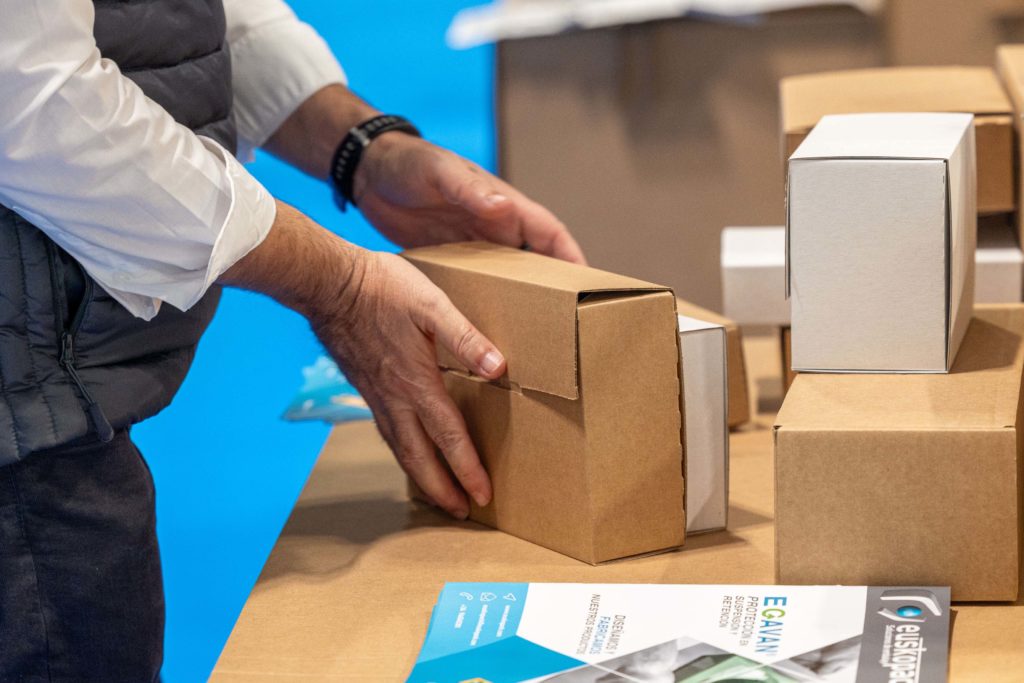
This is the ‘second chance boxes’ project, in which boxes, as you might expect, are given a second and, if possible, even a third, fourth, etc. chance before being recycled. ‘We are targeting the simple corrugated cardboard boxes that are widely used in SMEs. We are currently mapping out all the usable streams.’
In order to process this stream and give it a new lease of life, we are looking at social enterprises. “These are often located in the middle of SME zones, where cardboard boxes are thrown into containers en masse. We want to get this stream to them so that they can process it into new usable boxes, without recycling.” The only thing expected of participating SMEs is that they fold their boxes neatly and store them for collection. “It’s a little more work, but the many SMEs we spoke to don’t think it outweighs the sin of throwing them away.”
“We have already received plenty of positive feedback and want to be able to present the first figures in October to clarify the effect. In this initial phase, we need to generate as much awareness as possible and build a good reputation. Only then will we be able to appeal to more SMEs and later also approach large companies.”
Together for a better world
They may seem like ‘just’ cardboard boxes, but Ann does not want to minimise their importance. “What we are achieving with cardboard boxes may be achieved with something else in the future. The more measures like this we take, the better we will evolve towards a circular economy. I therefore hope above all that the lecture will inspire others, that nothing is impossible and that you are far from naive to want to improve something in this world,” she concludes.
Interested in how the RERUN project is taking shape? Are you a company with questions about processing cardboard boxes? Or do you have another question for Ann? Then come along to the lecture at Empack, from 22 to 23 October at the Nekkerhal in Mechelen.
Register for free here: https://register.visitcloud.com/survey/0lejfoc79a4bv.